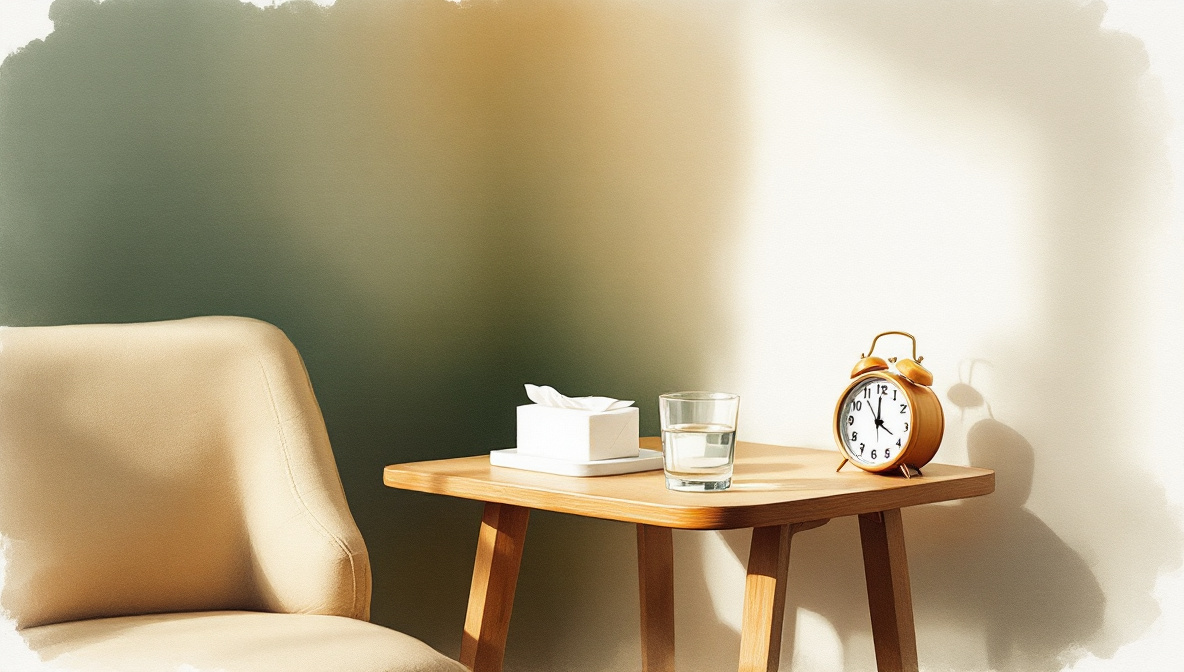
Crying in counselling is allowed. So is staying dry. What actually happens in the room, small ways to handle tears or flatness, and when to add other support safely.
Short answer. Yes. Crying in counselling is okay, and so is staying dry. In my room we make space for both; I slow the pace, offer water, and we pause or switch the camera off, then continue only when your body feels ready.
In short:
Tears are allowed here. When they come, we pause and make room; on video you can switch the camera off or type if speech is hard, and in person you can step out or rinse your face while I keep an eye on the time and bring water. Dry is welcome too.
You do not need to apologise. Some sessions call for words, others ask for breath and a steady glass of water on the table, and I pay attention to what steadies you more than to where the tears go. The hum of the air-conditioner and one long exhale can change a morning.
Flatness can protect you. After months of strain the body often keeps you safe by dimming everything, and pushing hard against that can make it clamp down further, so we work with it without trying to rip it open. I watch breath and shoulders, and I pay attention to what shifts across a normal week.
Track it this week. Notice when the sealed feeling is strongest: first thing, late evening, after back-to-back calls, or on the ride home; then note what softens it even one notch, like a longer shower or one honest line in a notes app. If this question nags you, read Am I lazy, unmotivated, or depressed?.
Tuesday afternoons go blank. When work has slipped into stale repetition, low mood can look the same from the outside; pushing harder rarely shifts boredom, while rest alone rarely shifts depression, and this walk-through can help you sort the difference: Am I depressed or just bored?.
Your session, your rules. Say what you need at the start; a hand signal for a tissue, permission to switch the camera off for a minute, a plan to step out to the sink, or a request that I speak less when you wave, and I will hold the time and check back with a simple yes or no.
We can go slow. When you are able, we find your feet on the floor and follow one longer exhale, then decide whether to continue, pause, stand to stretch, or circle back next time; the packet rustle of tissues is ordinary here, and a glass of water within reach can soften a locked throat.
This walk-through can help you decide whom to see: Counselling or therapy: what is the difference, and who should I see?.
Plan for the wobble. Decide one thing you will do if tears arrive and tell me in the first minute; a simple hand signal, or permission to turn the camera off for a minute, and I will carry the structure so you do not have to manage me while you manage yourself.
Words make it easier. If English sits awkwardly in your mouth that day, ask for Hindi if that is easier; I work in English and Hindi. Some people feel safer in person, others on video; choose the room that gives you a little more air, and we can revisit that choice whenever you want.
Embarrassment can burn hot. Bring it to the next session and put the crying itself on the table; we can look at what set it off, what you fear I now think of you, what helped you steady afterward, and how much room you want for feeling next time.
Only the facts, today. Between sessions, leave yourself a short, factual note instead of replaying the whole scene: where you were sitting, the exact sentence that tipped you, what changed in your breath, and roughly how long it took to steady. If shame has bitten your confidence, read How do I build self-esteem and self-worth as an adult?.
Tonight, keep it tiny. Place a soft handkerchief by your keys, write two lines you could read before a session: "If I cry, I'll pause and breathe.", close the notebook, and let the evening be ordinary again, because rest also counts.
Will crying make my counsellor think my problem is serious?
Tears show that your body is stirred. That is all. I pay attention to what set them off, what steadies you, and what you want next. Some sessions are full of words, others have long silences, and both can help. We work with tears, dryness, laughter, or quiet, depending on what your body brings that day.
What if I start crying and cannot stop?
We slow the pace. I will invite you to plant your feet, take one longer exhale, and decide whether to pause, switch the camera off for a minute, stand to stretch, or step out for water. Big waves often ease when pressure drops.
Is it rude if I do not cry in counselling?
Tears are optional. Dryness can be useful to study, especially after stress or burnout, because it shows how your body has been keeping you going. We will track other signals like breath, posture, sleep, and appetite, and we will look for whatever helps you feel even one notch safer so you can speak plainly.
Should I avoid make-up because I might cry?
Wear what feels easiest. Waterproof products help some people focus less on smudges, while others skip eye make-up that day. Keep a handkerchief nearby, and leave a few minutes after to freshen up before meetings or traffic. Your comfort matters more than the look, and small practicalities reduce fuss in the moment.
Written by Satlaj Sachan, a counsellor in Bengaluru working Book a first conversation.