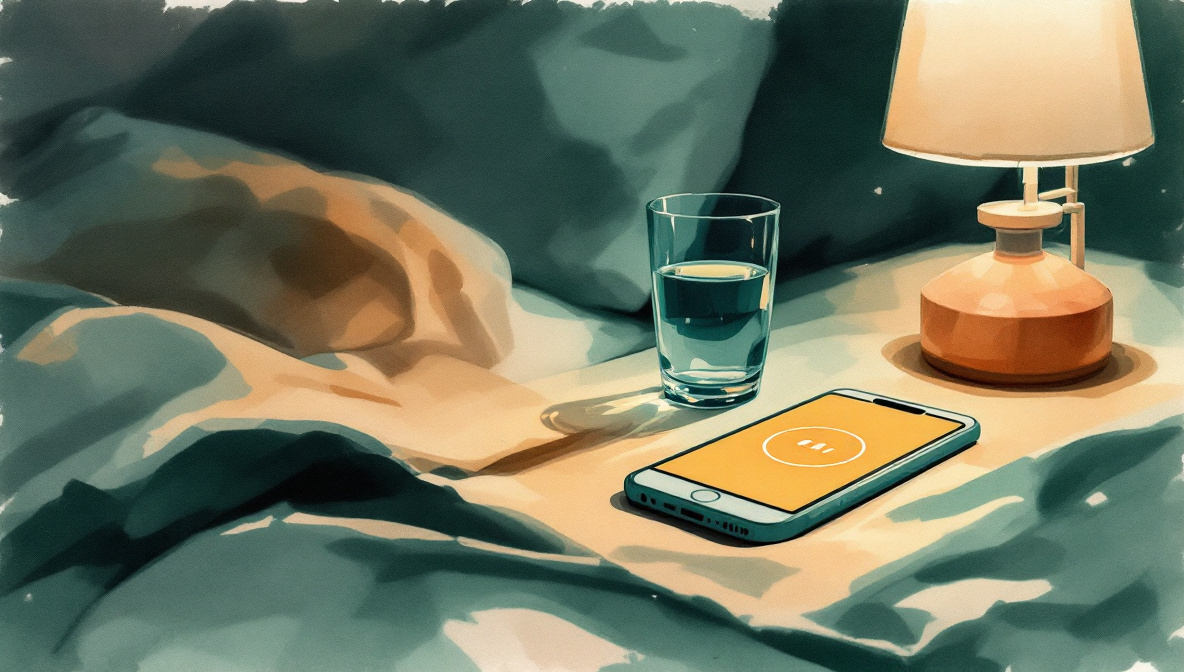
At 2 a.m., an app can steady your breath and hold a few lines. Across weeks, a person brings memory and company, with room for nuance. Choose the mix that fills the gap.
Short answer. Both can help, in different ways. An app is often enough at two in the morning for breath, a quick note, or a steady track; a person helps across weeks with memory and company, with room for nuance.
In short:
When you are awake and wired, your phone is the thing you can reach without leaving the bed. It is right there. A breathing track can steady your chest and a simple counter can slow the loop. Typing three lines can move the thought from your head to the screen so your shoulders soften and sleep has a chance again while the ceiling fan keeps its slow, ordinary hum.
Some apps are just timers with a line that grows and shrinks; others offer brief chats or journalling. Wysa is an Indian AI-first mental health app that escalates to a human when needed. Pick what you can open half-asleep with two taps because your brain at that hour wants fewer choices. I have watched a plain breathing track settle someone faster than a fancy dashboard ever could.

A person remembers you. Across weeks, I hold last session in mind, notice where you rush past the sentence that wants tears, name when your jaw clamps, slow you down when speeding up helps you avoid fear, and let humour enter so big feelings share a room with something lighter. That landing changes the work.
I am Satlaj Sachan, counsellor, Bengaluru. Practising since 2015. Rafiq means the friend who walks with you, and I try to keep that posture when you arrive late from traffic and say, 'I am fine. I do not know why I am here.' We start there and give it time.
Name the missing piece. If the honest line is 'I do not know what I feel', a person helps you find words and try them out loud; if the line is 'I know, but I cannot act', an app can hold drills on your schedule so decisions move from vague to doable during your actual weekday.
If you are choosing which profession to see, start with this piece: Counselling or therapy: what is the difference, and who should I see?. Try one session before any plan. After the call, notice your jaw and your breath. Also check whether you felt free to disagree, and if the fit was off, keep your shortlist moving.
Your timing matters here. Make time soon when sleep has kept failing for weeks or when panic blocks the door; reach out earlier if work is sliding and secrecy is growing, because the real price tends to show up in afternoon meetings where you need your full mind.
Before the first visit, write two lines: what keeps collapsing in your day, and what you want from the next fortnight. Bring a rough sleep window and anything you took and when, if that is part of the picture. A plain note on your phone is fine, even if you typed it in the auto outside the building.
Be boring about this. Read the privacy policy before you add one more account, turn off analytics you do not need, limit permissions, prefer local storage when a feature allows it, and check your lock settings so you can actually use the app without fretting about who might scroll later.
Keep a small paper notebook for feelings you do not want near a server. That little spiral on the kitchen table can hold the sentences you would hate to misplace in a shared album. People roll their eyes at this until the first time a sync hiccup makes them tense for the rest of the evening.
Language matters. If you think in two tongues or travel across states, choose support that can meet the words you actually use and a time zone that lets you arrive with a full brain. Convenience is a quiet form of care; it increases the chance you will show up on the day your energy is thin.
First meetings are practical. We check time, fee, where we meet, and what you hope might shift; I listen, ask a few plain questions, and we test the fit while keeping space for silence. Meeting can be arranged in a way that fits your week. You set the pace.
Between sessions, try tiny experiments so life does not turn into a project. If low mood and boredom blur together, this helps: Am I depressed or just bored?. When heavy work fatigue is pulling at you, read this before you set up your next week: Burnout symptoms and treatment: what should I look for, and what can help?. Use one idea, then rest.
When you book, you can say, 'Can we try three sessions and then review?' or 'Please slow me down when I start collecting tips.' Prefer plain language and room to pause. Tonight, put a small notebook by your bed and pin the one app you actually use to your home screen.
Can I start with an app and move to counselling later?
Yes. Begin with an app to steady nights on your schedule, then book one session and test the fit. Many people keep both: drills between meetings on the phone, and a person for pattern-spotting and decisions. Change the mix as your life changes. There is no prize for picking one tool forever; adjust when your week demands something different.
Are mental health apps a replacement for counselling?
Different jobs. Apps offer techniques and structure whenever you reach for them, especially at odd hours. Counselling offers attention and shared memory, with room to be slowed down or challenged in real time. Use the tool that matches your need this week. Reach for your phone at two in the morning. Reach for a person across weeks when you want company that thinks with you.
How do I find a counsellor who fits me?
Make a short list and read what they write. Ask two questions you actually care about and try one session. Afterward, notice your jaw and your breath, then ask if you felt free to say 'no'. Email again only if the fit felt workable. If cost or timing is tight, ask for a cadence that protects both your energy and your wallet.
What if I cannot afford weekly sessions?
Use options you already have through work if they exist. Space sessions two or four weeks apart and agree on a focus for each meeting. Keep notes between sessions so you can land quickly, and let an app hold simple practice. It is fine to adjust cadence during months that stretch your budget or energy; be upfront so you can plan together.
How private are mental health apps, really?
Privacy varies. Read the policy, turn off analytics you do not need, limit permissions, and prefer local storage when possible. Set a phone lock that suits your home, and keep a paper notebook for anything you would rather keep offline. These steps are dull. They lower worry and help you use the tool on the night you need it.
Written by Satlaj Sachan, a counsellor in Bengaluru working Book a first conversation.